<?xml version="1.0" encoding="utf-8"?>
<feed xmlns="http://www.w3.org/2005/Atom">
    <id>https://docs.lending.akkuro.com/blog</id>
    <title>Documentation · Akkuro Lending Blog</title>
    <updated>2026-02-10T00:00:00.000Z</updated>
    <generator>https://github.com/jpmonette/feed</generator>
    <link rel="alternate" href="https://docs.lending.akkuro.com/blog"/>
    <subtitle>Documentation · Akkuro Lending Blog</subtitle>
    <icon>https://docs.lending.akkuro.com/img/favicon.svg</icon>
    <entry>
        <title type="html"><![CDATA[Exploring our Unified Domain Model documentation]]></title>
        <id>https://docs.lending.akkuro.com/blog/2026/02/10/domain-model-documentation</id>
        <link href="https://docs.lending.akkuro.com/blog/2026/02/10/domain-model-documentation"/>
        <updated>2026-02-10T00:00:00.000Z</updated>
        <summary type="html"><![CDATA[Discover the latest updates to our API documentation.]]></summary>
        <content type="html"><![CDATA[<p>When you’re building or integrating with Akkuro Lending, one of the biggest challenges is ensuring that everyone and every systems speak the same language. Data flows across services, APIs, and databases can become complex, and that's why Akuro Lending uses a Unified Domain Model (UDM) as a common language that can bring clarity and consistency to the entire Lending ecosystem.</p>
<p>Therefore, we are pleased to introduce our Domain Model documentation. This documentation gives you the business context behind our data, helping you better understand Akkuro Lending and use our API schema with confidence.</p>
<h2 class="anchor anchorWithStickyNavbar_LWe7" id="what-is-the-unified-domain-model">What is the Unified Domain Model?<a href="https://docs.lending.akkuro.com/blog/2026/02/10/domain-model-documentation#what-is-the-unified-domain-model" class="hash-link" aria-label="Direct link to What is the Unified Domain Model?" title="Direct link to What is the Unified Domain Model?">​</a></h2>
<p>The Unified Domain Model is a standardized, business-driven representation of real-world concepts and objects related to lending. Akkuro Lending organizes objects by functional domain, such as counterparty and collateral. The UDM forms the foundation that keeps the entire Lending ecosystem working together smoothly and serves as a guideline for data storage.</p>
<p>This improves communication between components, increases data consistency, reduces mapping errors and ambiguity, and simplifies integration across different systems and teams.</p>
<p>To learn more, check out the <a href="https://docs.lending.akkuro.com/public/domain-model/domain-model-overview">Domain model overview</a>.</p>
<h2 class="anchor anchorWithStickyNavbar_LWe7" id="what-our-domain-model-documentation-offers">What our Domain Model documentation offers<a href="https://docs.lending.akkuro.com/blog/2026/02/10/domain-model-documentation#what-our-domain-model-documentation-offers" class="hash-link" aria-label="Direct link to What our Domain Model documentation offers" title="Direct link to What our Domain Model documentation offers">​</a></h2>
<p>If you’re exploring how your system can integrate with us, or you simply want to understand how our lending domain is structured, this documentation is your go-to resource.</p>
<p>To make these concepts easy to grasp, the docs include simplified diagrams inspired by UML class diagrams. These visuals highlight the essential classes, attributes, and relationships you need to understand how data is organized. These visuals help you quickly understand how lending data is structured, plan smoother integrations, and see how different parts of the platform fit together.</p>
<p>Moreover, this documentation shows not just the data structure, but also explains the business meaning behind the data. It gives you the big picture of our domain model, helping you understand what the data means.</p>
<p>Currently, our documentation covers the following functional domains:</p>
<ul>
<li><a href="https://docs.lending.akkuro.com/public/domain-model/counterparties">Counterparties</a></li>
<li><a href="https://docs.lending.akkuro.com/public/domain-model/collaterals">Collaterals</a></li>
<li><a href="https://docs.lending.akkuro.com/public/domain-model/file-documents">File Documents</a></li>
<li><a href="https://docs.lending.akkuro.com/public/domain-model/financing-execution">Financing Execution</a></li>
<li><a href="https://docs.lending.akkuro.com/public/domain-model/financing-solutions">Financing Solutions</a></li>
<li><a href="https://docs.lending.akkuro.com/public/domain-model/private-financials">Private Financials</a></li>
<li><a href="https://docs.lending.akkuro.com/public/domain-model/process-orchestration">Process Orchestration</a></li>
</ul>
<h2 class="anchor anchorWithStickyNavbar_LWe7" id="how-to-use-our-documentation">How to use our documentation<a href="https://docs.lending.akkuro.com/blog/2026/02/10/domain-model-documentation#how-to-use-our-documentation" class="hash-link" aria-label="Direct link to How to use our documentation" title="Direct link to How to use our documentation">​</a></h2>
<p>The Domain Model documentation and the API Schema are designed to work hand in hand:</p>
<ul>
<li>The Domain Model documentation explains the domain concepts</li>
<li>The API schema shows you how to interact with the APIs</li>
</ul>
<p>By starting with the Domain Model documentation, you’ll understand the core concepts, how objects depend on each other, and which APIs to use at each stage of a business flow. This reduces guesswork, shortens integration time, and leads to cleaner, more reliable implementations.</p>]]></content>
        <author>
            <name>Akkuro Lending Development Team</name>
        </author>
        <category label="api" term="api"/>
        <category label="documentation" term="documentation"/>
        <category label="domain model" term="domain model"/>
        <category label="data" term="data"/>
    </entry>
    <entry>
        <title type="html"><![CDATA[Akkuro Lending introduces the Migration Assistance API for safer and easier data migration]]></title>
        <id>https://docs.lending.akkuro.com/blog/2025/11/24/data-migration-introduction</id>
        <link href="https://docs.lending.akkuro.com/blog/2025/11/24/data-migration-introduction"/>
        <updated>2025-11-24T00:00:00.000Z</updated>
        <summary type="html"><![CDATA[Discover how Akkuro Lending’s Migration Assistance API makes data migration faster, safer, and easier for developers.]]></summary>
        <content type="html"><![CDATA[<p>Have you ever found data migration daunting, risky, and full of “what if something breaks?” moments? Migrating data from one system to another has always been one of those complex challenges for development teams. Data migration requires meticulous planning and precision since it’s a process where even one mistake can cause major disruptions.</p>
<p>That’s where our brand-new Migration Assistance API comes in. It helps you move existing data from your current systems into the Akkuro Lending platform, making your data migration journey easier, faster, and more secure. Let's learn what it can offer.</p>
<h2 class="anchor anchorWithStickyNavbar_LWe7" id="what-is-the-migration-assistance-api">What is the Migration Assistance API?<a href="https://docs.lending.akkuro.com/blog/2025/11/24/data-migration-introduction#what-is-the-migration-assistance-api" class="hash-link" aria-label="Direct link to What is the Migration Assistance API?" title="Direct link to What is the Migration Assistance API?">​</a></h2>
<p>The Migration Assistance API acts as your assistant to help you along your data migration journey. You can also think of this API as your migration safety net. It’s not just about moving data, it’s also about doing it right. With validation, an isolated staging environment, and compliance built in, you can migrate confidently without worrying about data leaks or broken records.</p>
<p>The migration goal is simple: move data securely, accurately, and with minimal disruption. Therefore, our Migration Assistance API is designed to make the migration process smooth, controlled, safe, and efficient without extra coding.</p>
<p>Currently, you can migrate data into the following Akkuro Lending domains:</p>
<ul>
<li><strong>Counterparties</strong>: Includes all information related to borrowers, whether individuals or organizations.</li>
<li><strong>Collaterals</strong>: Includes all information related to assets used as security for loans.</li>
</ul>
<h2 class="anchor anchorWithStickyNavbar_LWe7" id="key-benefits">Key benefits<a href="https://docs.lending.akkuro.com/blog/2025/11/24/data-migration-introduction#key-benefits" class="hash-link" aria-label="Direct link to Key benefits" title="Direct link to Key benefits">​</a></h2>
<p>Here’s what makes the Migration Assistance API a powerful companion:</p>
<ul>
<li>
<p><strong>Staging area</strong>: Upload your data to a secure, isolated environment where you can validate everything before it touches your target environment. No surprises, no risks.</p>
</li>
<li>
<p><strong>Data streaming</strong>: Large datasets? We've got you covered. We support JSON Lines (JSONL) and JSON Text Sequences (JSON-seq) data formats, so you can stream records continuously instead of wrestling with one giant file.</p>
</li>
<li>
<p><strong>Domain-specific migration</strong>: Move data into lending domains like Counterparties and Collaterals. You can choose to migrate only what you need.</p>
</li>
<li>
<p><strong>Privacy and compliance built in</strong>: No personal data in logs, isolated environments for each migration, and a full audit trail for peace of mind.</p>
</li>
<li>
<p><strong>Granular access control</strong>: Only authorized users can migrate data, and you can grant read-only access for monitoring.</p>
</li>
</ul>
<h2 class="anchor anchorWithStickyNavbar_LWe7" id="data-migration-journey">Data migration journey<a href="https://docs.lending.akkuro.com/blog/2025/11/24/data-migration-introduction#data-migration-journey" class="hash-link" aria-label="Direct link to Data migration journey" title="Direct link to Data migration journey">​</a></h2>
<p>To give you a quick picture of migration journey in Akkuro Lending, here’s the overall flow:</p>
<!-- -->
<p>If you'd like to go deeper, dive into these resources to start your journey:</p>
<ul>
<li><a href="https://docs.lending.akkuro.com/public/capabilities/data-migration/about-data-migration">A detailed step-by-step migration guide</a></li>
<li><a href="https://schemas.lending.akkuro.com/browse/lending/migration-assistance" target="_blank" rel="noopener noreferrer">Migration Assistance API schema</a></li>
</ul>
<p>These resources provide detailed instructions and API references to help you get started.</p>
<h2 class="anchor anchorWithStickyNavbar_LWe7" id="whats-next">What's next<a href="https://docs.lending.akkuro.com/blog/2025/11/24/data-migration-introduction#whats-next" class="hash-link" aria-label="Direct link to What's next" title="Direct link to What's next">​</a></h2>
<p>At this initial phase, you can only migrate data into two Akkuro Lending domains: Counterparties and Collaterals. We are working to expand support for additional data domains. We will share updates as soon as they’re available.</p>
<p>Your data deserves a smooth landing. With Akkuro Lending’s Migration Assistance API, your data migration becomes predictable, secure, and efficient.</p>]]></content>
        <author>
            <name>Akkuro Lending Development Team</name>
        </author>
        <category label="api" term="api"/>
        <category label="data migration" term="data migration"/>
    </entry>
    <entry>
        <title type="html"><![CDATA[Discover webhooks, streaming, and more in the latest API Docs]]></title>
        <id>https://docs.lending.akkuro.com/blog/2025/09/18/docs-update</id>
        <link href="https://docs.lending.akkuro.com/blog/2025/09/18/docs-update"/>
        <updated>2025-09-18T00:00:00.000Z</updated>
        <summary type="html"><![CDATA[Discover the latest updates to our API documentation.]]></summary>
        <content type="html"><![CDATA[<p>We’re back with the second major update to our API documentation. This update introduces new concepts and feature guides designed to help developers build faster, smarter, and more resilient integrations.</p>
<p>By reading this article, you can also explore the capabilities that we offer to help you use our APIs more efficiently.</p>
<h2 class="anchor anchorWithStickyNavbar_LWe7" id="whats-new">What’s new?<a href="https://docs.lending.akkuro.com/blog/2025/09/18/docs-update#whats-new" class="hash-link" aria-label="Direct link to What’s new?" title="Direct link to What’s new?">​</a></h2>
<p>We’re continuously improving the Akkuro Lending API documentation to enhance the developer experience. In this release, we’ve added new documentation outlining our core principles and standards that apply across all APIs, along with feature guides detailing the capabilities currently supported.</p>
<h3 class="anchor anchorWithStickyNavbar_LWe7" id="content-types-and-data-format">Content types and data format<a href="https://docs.lending.akkuro.com/blog/2025/09/18/docs-update#content-types-and-data-format" class="hash-link" aria-label="Direct link to Content types and data format" title="Direct link to Content types and data format">​</a></h3>
<p>We've standardized and documented the common content types and data formats used in API requests and responses, along with examples to help developers parse them correctly and ensure reliable data processing.</p>
<p>Check out <a href="https://docs.lending.akkuro.com/public/api-reference/data-formats">Data format</a> for more details.</p>
<h3 class="anchor anchorWithStickyNavbar_LWe7" id="status-codes-and-error-handling">Status codes and error handling<a href="https://docs.lending.akkuro.com/blog/2025/09/18/docs-update#status-codes-and-error-handling" class="hash-link" aria-label="Direct link to Status codes and error handling" title="Direct link to Status codes and error handling">​</a></h3>
<p>We've added a list of all possible success and error codes returned by Akkuro Lending APIs and troubleshooting tips. We also explain the standard error message format, defined in <a href="https://datatracker.ietf.org/doc/html/rfc7807" target="_blank" rel="noopener noreferrer">RFC 7807</a>, which helps you debug faster.</p>
<p>Check out <a href="https://docs.lending.akkuro.com/public/api-reference/error-codes-responses">Status codes and error handling</a> for more details.</p>
<h3 class="anchor anchorWithStickyNavbar_LWe7" id="pagination">Pagination<a href="https://docs.lending.akkuro.com/blog/2025/09/18/docs-update#pagination" class="hash-link" aria-label="Direct link to Pagination" title="Direct link to Pagination">​</a></h3>
<p>Some APIs that list or retrieve collections of items may return super-large volumes of data in a single response. This can lead to slow response, server strain, timeouts, or system failures.</p>
<p>Pagination helps you resolve these issues. This approach improves user experience by reducing page load times, preventing overwhelming users with too much information at once, and allowing them to navigate content more easily.</p>
<p>Check out <a href="https://docs.lending.akkuro.com/public/api-reference/use-pagination">Pagination</a> for further details.</p>
<h3 class="anchor anchorWithStickyNavbar_LWe7" id="streaming-data">Streaming data<a href="https://docs.lending.akkuro.com/blog/2025/09/18/docs-update#streaming-data" class="hash-link" aria-label="Direct link to Streaming data" title="Direct link to Streaming data">​</a></h3>
<p>If your application frequently downloads large datasets and suffers from slow responses or system strain, our streaming APIs offer a scalable solution.</p>
<p>Streaming APIs allow your application to download large datasets. Data is delivered incrementally as JSON objects over a persistent connection, so your application can process the data immediately as it arrives, instead of requiring the entire dataset to be available before sending.</p>
<p>Check out <a href="https://docs.lending.akkuro.com/public/api-reference/streaming-data">Streaming data</a> for further details.</p>
<h3 class="anchor anchorWithStickyNavbar_LWe7" id="webhooks">Webhooks<a href="https://docs.lending.akkuro.com/blog/2025/09/18/docs-update#webhooks" class="hash-link" aria-label="Direct link to Webhooks" title="Direct link to Webhooks">​</a></h3>
<p>If you need to receive near real-time notifications directly to your system, Webhooks are a great choice.</p>
<p>Webhooks let you subscribe to some specific events or changes happening in the Akkuro Lending platform in real-time, and your server is automatically notified and receives a delivery of data whenever those events occur.</p>
<p>Check out <a href="https://docs.lending.akkuro.com/public/api-reference/webhooks/about-webhooks">Webhooks</a> for further details.</p>
<h2 class="anchor anchorWithStickyNavbar_LWe7" id="explore-the-docs">Explore the docs<a href="https://docs.lending.akkuro.com/blog/2025/09/18/docs-update#explore-the-docs" class="hash-link" aria-label="Direct link to Explore the docs" title="Direct link to Explore the docs">​</a></h2>
<p>Explore our <a href="https://docs.lending.akkuro.com/" target="_blank" rel="noopener noreferrer">Akkuro Lending documentation</a> site to discover all the latest updates. We’d love to have your feedback.</p>
<p>We will continue expanding our documentation to give you deeper insight into the Akkuro Lending domain model, helping you use our APIs more efficiently.</p>]]></content>
        <author>
            <name>Akkuro Lending Development Team</name>
        </author>
        <category label="api" term="api"/>
        <category label="documentation" term="documentation"/>
        <category label="integration" term="integration"/>
        <category label="pagination" term="pagination"/>
        <category label="webhooks" term="webhooks"/>
        <category label="streaming data" term="streaming data"/>
    </entry>
    <entry>
        <title type="html"><![CDATA[Introducing our new Akkuro Lending API documentation]]></title>
        <id>https://docs.lending.akkuro.com/blog/2025/08/11/doc-site-introduction</id>
        <link href="https://docs.lending.akkuro.com/blog/2025/08/11/doc-site-introduction"/>
        <updated>2025-08-11T00:00:00.000Z</updated>
        <summary type="html"><![CDATA[Discover our new public API documentation, built for developers to enhance their integration experience.]]></summary>
        <content type="html"><![CDATA[<p>In the fast-paced world of technology, innovation gives rise to powerful tools—but it's the user's understanding that truly unlocks their potential. That’s why we’re thrilled to announce the first release of our new API documentation for the Akkuro Lending platform. Designed with clarity and usability in mind, the new site offers a clean, consistent, and professional interface to help you get started quickly and integrate our banking services seamlessly into your applications.</p>
<p>At Akkuro Lending, as we’re constantly rolling out new features and expanding our API offerings, we remain committed to delivering a developer experience that’s smooth, simple, and transparent.</p>
<h2 class="anchor anchorWithStickyNavbar_LWe7" id="what-we-offer">What we offer<a href="https://docs.lending.akkuro.com/blog/2025/08/11/doc-site-introduction#what-we-offer" class="hash-link" aria-label="Direct link to What we offer" title="Direct link to What we offer">​</a></h2>
<p>The new Akkuro Lending API documentation site is built with developers in mind, offering:</p>
<ul>
<li>
<p>Intuitive navigation: Easily find what you need with a clean, user-friendly navigation bar and sidebar.</p>
</li>
<li>
<p>User-friendly reading interface: Enjoy a clean design and typography for a better reading experience. Each documentation page is clearly structured with headings and a built-in table of contents, making it easier to scan and navigate.</p>
</li>
<li>
<p>Comprehensive guides: Step-by-step tutorials, real-world examples, and troubleshooting tips make it easy for developers of all experience levels to get started and go deep.</p>
</li>
<li>
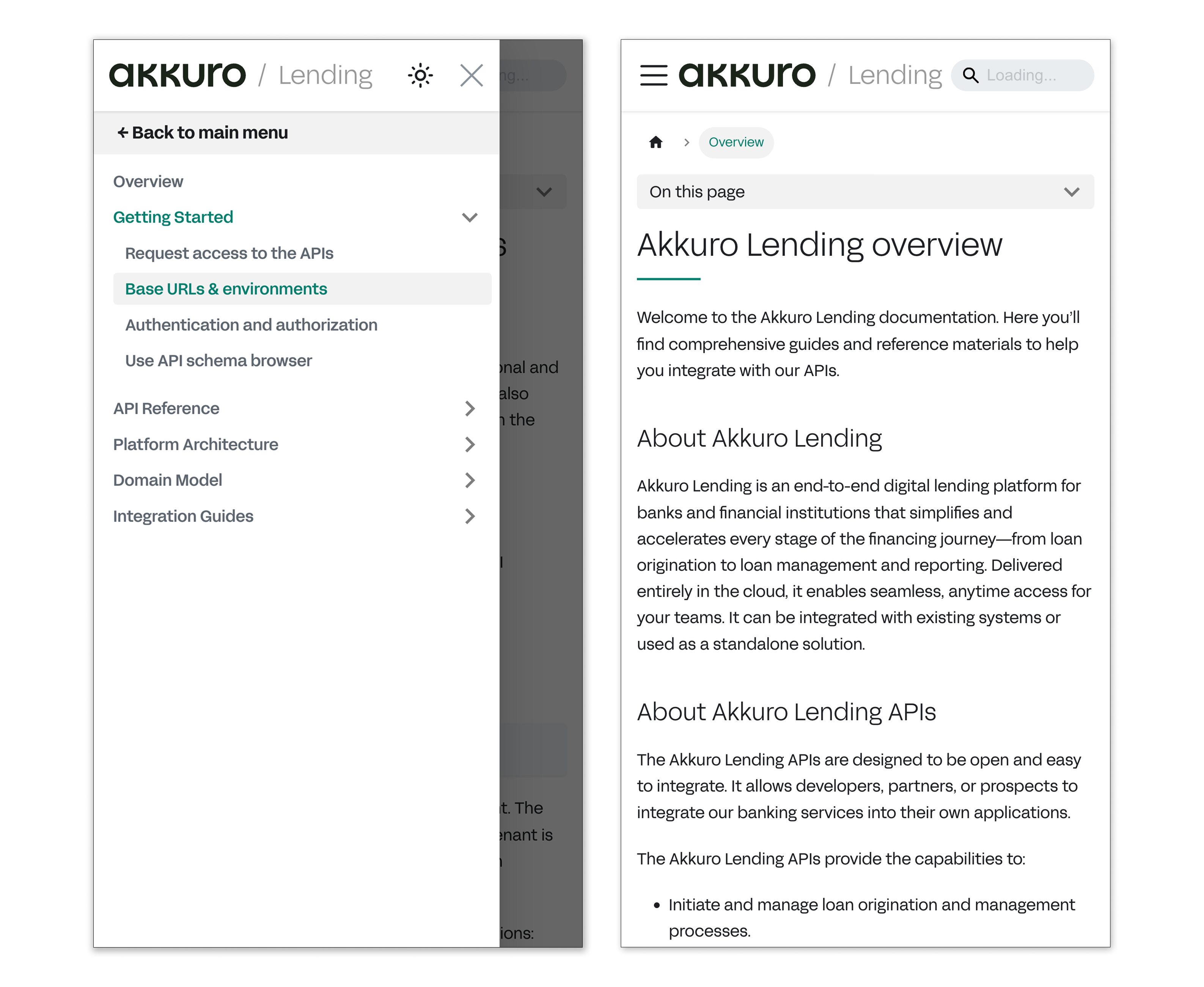
<p>Responsive design: Whether you're on a desktop, tablet, or smartphone, our documentation adapts seamlessly. You can learn and read our documentation from any device, anywhere, in a way that fits your work style.</p>
</li>
</ul>
<h2 class="anchor anchorWithStickyNavbar_LWe7" id="about-our-documentation-site">About our documentation site<a href="https://docs.lending.akkuro.com/blog/2025/08/11/doc-site-introduction#about-our-documentation-site" class="hash-link" aria-label="Direct link to About our documentation site" title="Direct link to About our documentation site">​</a></h2>
<p>The first launch of the Akkuro Lending API documentation includes two sites:</p>
<ul>
<li>API documentation</li>
<li>API schemas</li>
</ul>
<h3 class="anchor anchorWithStickyNavbar_LWe7" id="api-documentation">API documentation<a href="https://docs.lending.akkuro.com/blog/2025/08/11/doc-site-introduction#api-documentation" class="hash-link" aria-label="Direct link to API documentation" title="Direct link to API documentation">​</a></h3>
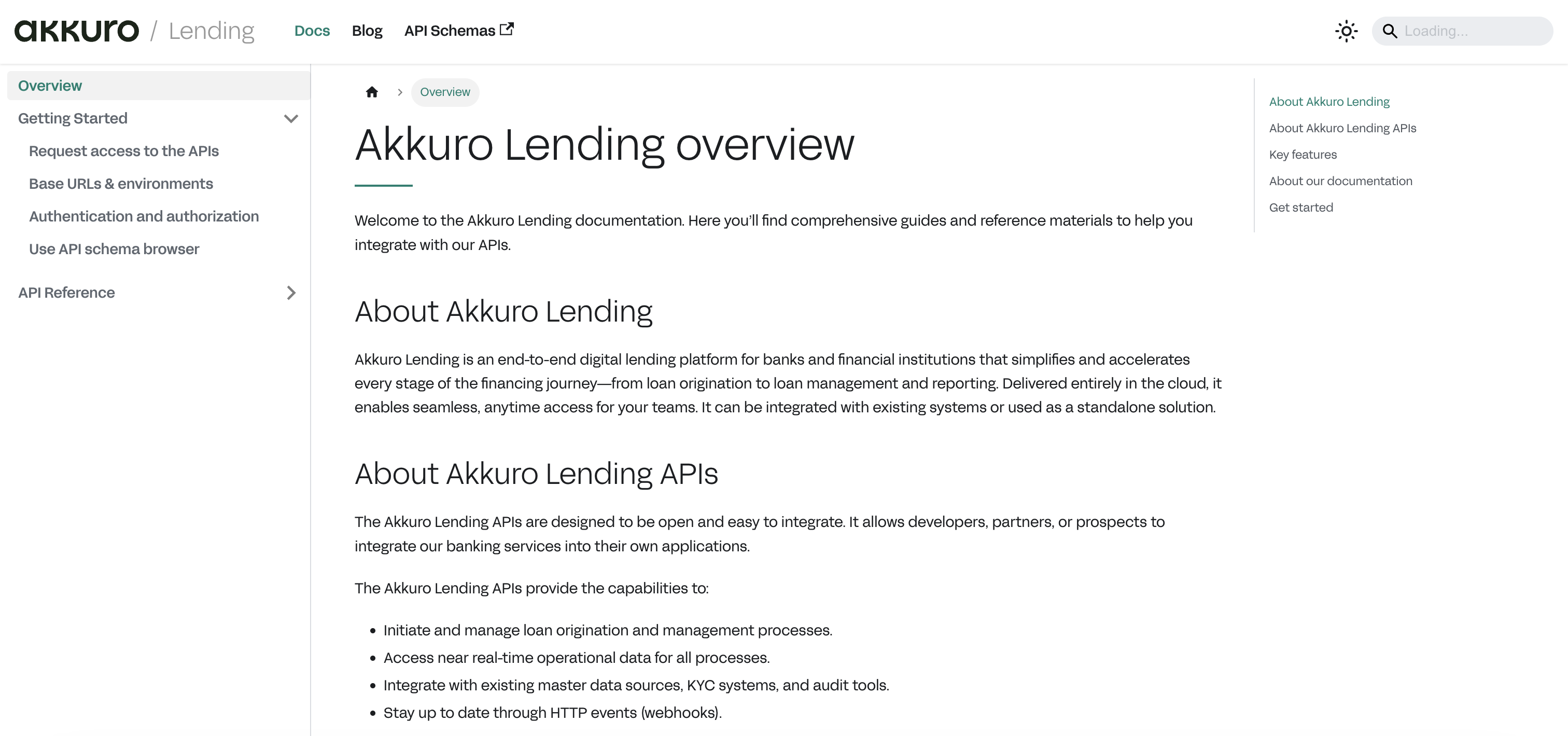
<p>The Akkuro Lending API documentation site includes step-by-step tutorials, integration walkthroughs, and architectural overviews to help you understand our services.</p>
<p>You can access the API documentation <a href="https://docs.lending.akkuro.com/" target="_blank" rel="noopener noreferrer">here</a>.</p>
<p><img decoding="async" loading="lazy" alt="The API documentation page" src="https://docs.lending.akkuro.com/assets/images/documentation-page-813f630f5c8d779b55fc6b55a67f217d.png" width="3024" height="1419" class="img_ev3q"></p>
<p>You can also comfortably navigate and read our documentation on other devices.</p>
<p><img decoding="async" loading="lazy" alt="The API documentation page on mobile" src="https://docs.lending.akkuro.com/assets/images/documentation-page-on-mobile-bab2c5082a4616a74f4c554a419cb7e5.png" width="3174" height="2601" class="img_ev3q"></p>
<h3 class="anchor anchorWithStickyNavbar_LWe7" id="api-schemas">API schemas<a href="https://docs.lending.akkuro.com/blog/2025/08/11/doc-site-introduction#api-schemas" class="hash-link" aria-label="Direct link to API schemas" title="Direct link to API schemas">​</a></h3>
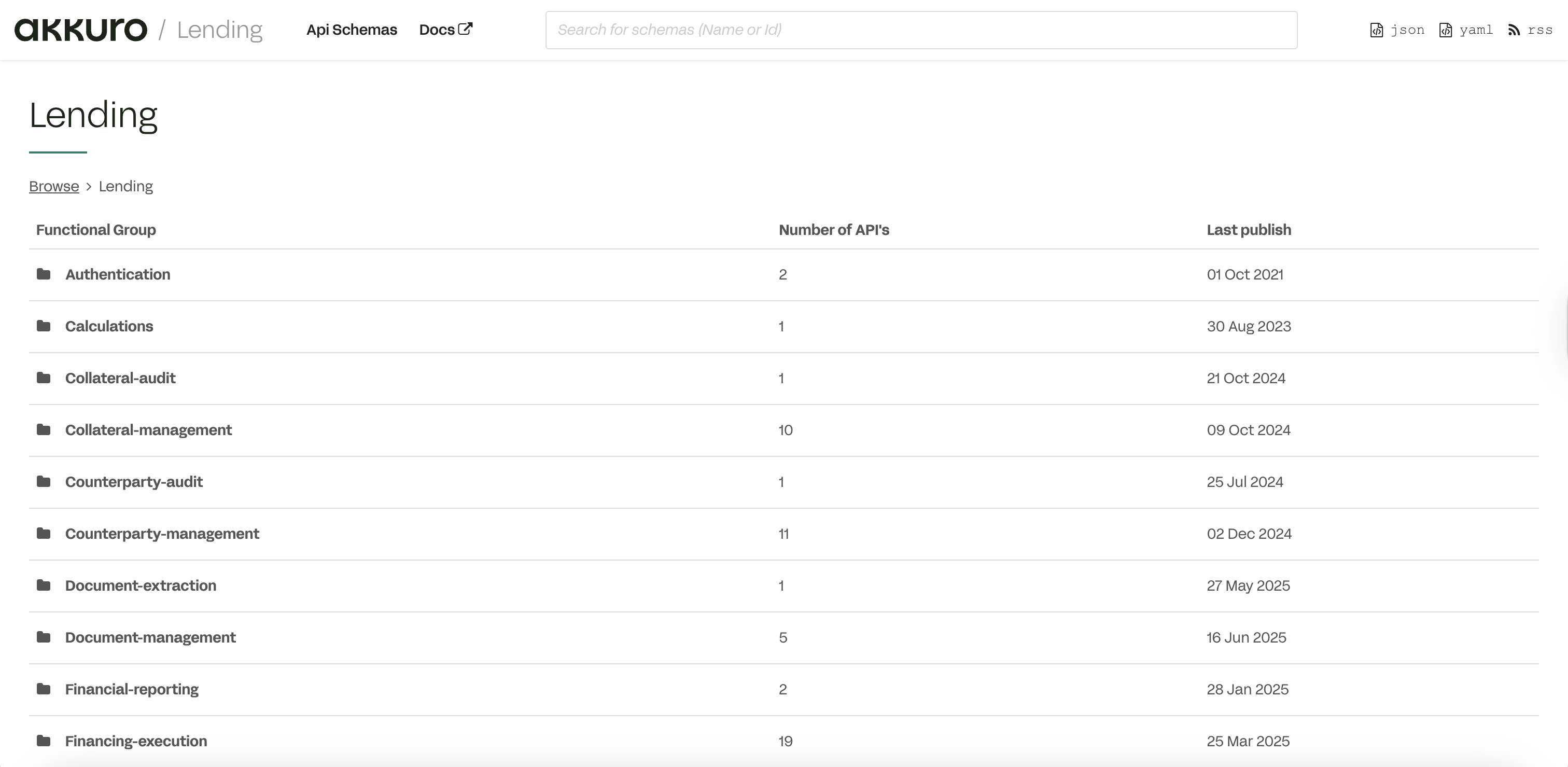
<p>The API schemas site provides technical reference for all APIs documented using OpenAPI specifications, including endpoints, parameters, data formats, and error responses.</p>
<p>You can access the API schemas <a href="https://schemas.lending.akkuro.com/browse" target="_blank" rel="noopener noreferrer">here</a>.</p>
<p><img decoding="async" loading="lazy" alt="The API schema documentation page" src="https://docs.lending.akkuro.com/assets/images/API-schema-browser-ef88dd0c861af27635e36205c35ecee8.png" width="3024" height="1479" class="img_ev3q"></p>
<h2 class="anchor anchorWithStickyNavbar_LWe7" id="whats-in-the-first-release">What's in the first release<a href="https://docs.lending.akkuro.com/blog/2025/08/11/doc-site-introduction#whats-in-the-first-release" class="hash-link" aria-label="Direct link to What's in the first release" title="Direct link to What's in the first release">​</a></h2>
<p>Here’s what’s included in this first release:</p>
<ul>
<li>Overview of the Akkuro Lending API documentation. See <a href="https://docs.lending.akkuro.com/" target="_blank" rel="noopener noreferrer">Akkuro Lending overview</a>.</li>
<li>Learn how to request access to our API. See <a href="https://docs.lending.akkuro.com/public/getting-started/how-to-get-access">Request access to the APIs</a>.</li>
<li>Understand how to work with different regions and environments. See <a href="https://docs.lending.akkuro.com/public/getting-started/base-urls-environments">Base URLs &amp; Environments</a>.</li>
<li>Learn how to securely authenticate and authorize your requests. See <a href="https://docs.lending.akkuro.com/public/getting-started/authentication">Authentication and authorization</a></li>
<li>Explore how to use the schema browser to navigate available APIs and schemas. See <a href="https://docs.lending.akkuro.com/public/getting-started/use-schema-browser">Use API schema browser</a>.</li>
<li>Learn how to specify and manage different API versions. See <a href="https://docs.lending.akkuro.com/public/api-reference/api-versioning">API Versioning</a>.</li>
</ul>
<h2 class="anchor anchorWithStickyNavbar_LWe7" id="whats-next">What's next<a href="https://docs.lending.akkuro.com/blog/2025/08/11/doc-site-introduction#whats-next" class="hash-link" aria-label="Direct link to What's next" title="Direct link to What's next">​</a></h2>
<p>We’re just getting started. Our goal is to continue to actively grow and improve our documentation to better support your development journey. That means adding new guides, updating schemas, and expanding real-world use cases, so you can get the most out of our platform with ease.</p>
<p>Your feedback plays a vital role in shaping this experience. If you have suggestions, questions, or spot something we can do better, we’d love to hear from you.</p>]]></content>
        <author>
            <name>Akkuro Lending Development Team</name>
        </author>
        <category label="api" term="api"/>
        <category label="documentation" term="documentation"/>
        <category label="schema" term="schema"/>
        <category label="integration" term="integration"/>
    </entry>
</feed>