Financing Execution
Overview
This document provides diagrams that illustrate relationships within the Financing Execution domain. By understanding this model, you can visualize the complete data structure behind the Financing Execution API, including how classes and attributes are organized and how their relationships are represented.
For a detailed description of each class and its attributes, refer to Financing Execution API.
Financing execution
Financing Execution domain represents the phase where the loan agreement is activated and all related financial and legal components are executed. This phase shows the ongoing financial activities that occur.
The Financing Execution domain includes the following subdomains:
Debit mandates
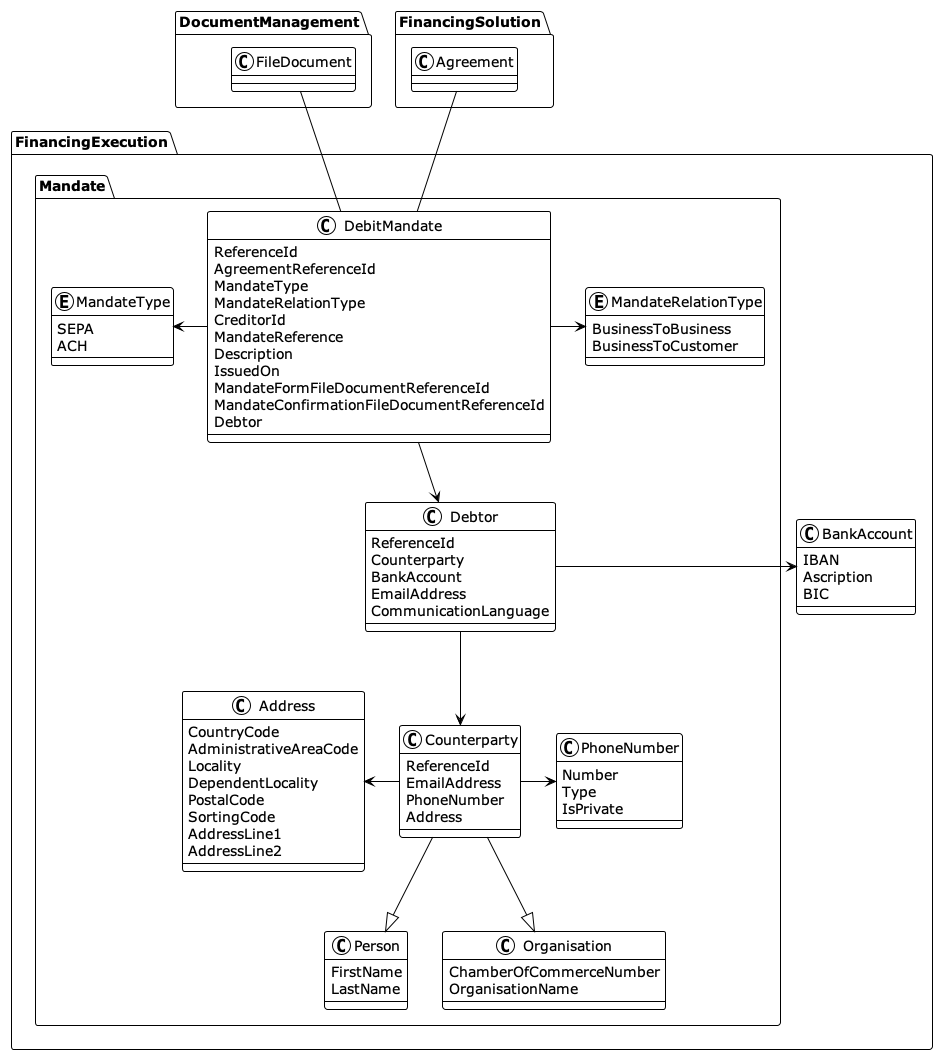
A debit mandate is an authorization that allows the lender to automatically collect payments from the borrower’s bank account, either as a one-time transaction or on a recurring basis. The DebitMandate object stores the debit mandate information.
To retrieve stored debit mandate information, use one of the following APIs:
- Debit Mandate Master Query API retrieves master record data.
- Debit Mandate Operation Query API retrieves operational data.
Akkuro Lending supports two types of mandates:
- Single Euro Payments Area (SEPA): A debit mandate that authorizes direct debit payments in euros, which means it accepts payments from borrowers with a European bank account.
- Automated Clearing House (ACH): A debit mandate that authorizes electronic direct debit payments in USD, which means it accepts payments from borrowers with a United States bank account.
There are two types of mandate relation:
- Business-to-Business (BTB): The debit authorization exists with an organization. Typically used for corporate loans or inter-company transactions.
- Business-to-Customer (BTC): The debit authorization exists with an individual counterparty. Commonly used for personal loans.
Debtors
A debit mandate is provided by a debtor. A debtor can be either a person or an organisation. The Debtors object stores information about the debtor at the time the debit mandate is provided. This data is stored separately from the Counterparty Management API.
Addresses
Refer to Addresses for further information.
Notary
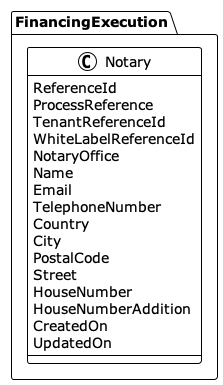
A notary is an authorized official responsible for managing the release of collateral associated with a loan agreement. In property transactions, the notary also handles financial matters. After confirming that all legal conditions are met, the notary releases the funds to the seller and notifies the Land Registry to update the ownership records by registering the mortgage and property. The Notary object records the personal information of a notary.
To retrieve personal information and contact details of a notary, use the Notary Query Operational API.
Disbursements
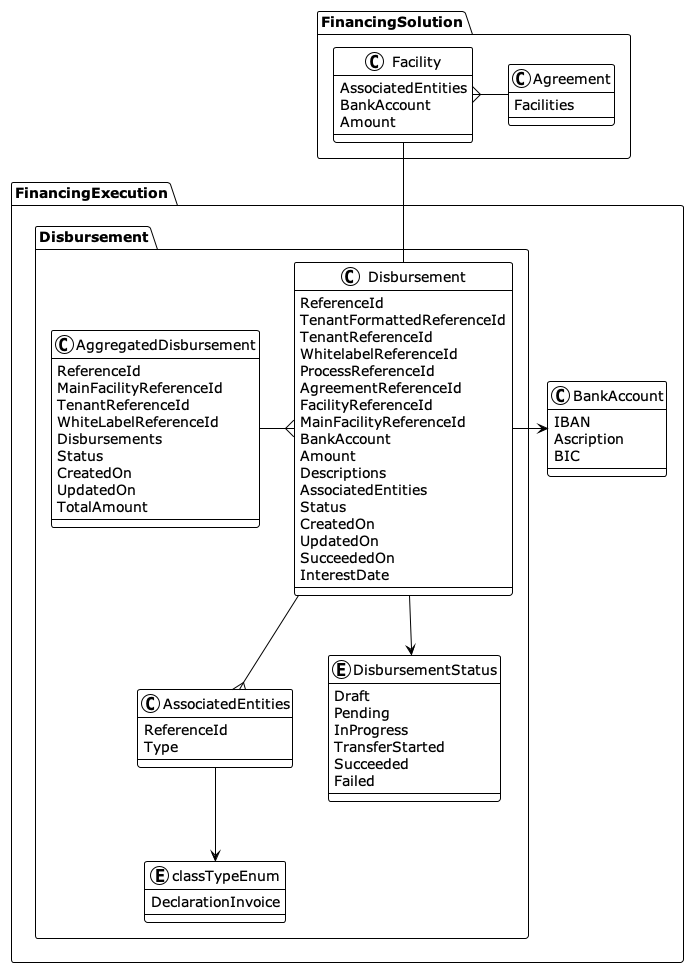
A disbursement represents the transfer of an approved loan amount from the lender to the borrower or a related third party. It can occur as a one-time payment or in multiple installments, depending on the loan agreement. Disbursements may also include payments for associated costs, such as notary fees, if specified in the agreement.
A disbursement can also be created based on a declaration invoice. The borrowers may submit a declaration invoice to indicate the amount they need to be disbursed. This invoice can originate from either the borrower or a supplier. Once the invoice is reviewed and approved, the system generates a disbursement to pay the amount specified in the invoice. The Associatedclasses field links a disbursement to its related invoice.
To retrieve disbursement records, use this Disbursement Query API.
Aggregated disbursements
An aggregated disbursement is created by grouping multiple disbursements that share the same following detailed information:
DescriptionsMainFacilityReferenceIdIBANCurrency
To retrieve streams of aggregated disbursements, use this Streaming Aggregated Disbursement API.
Financial states
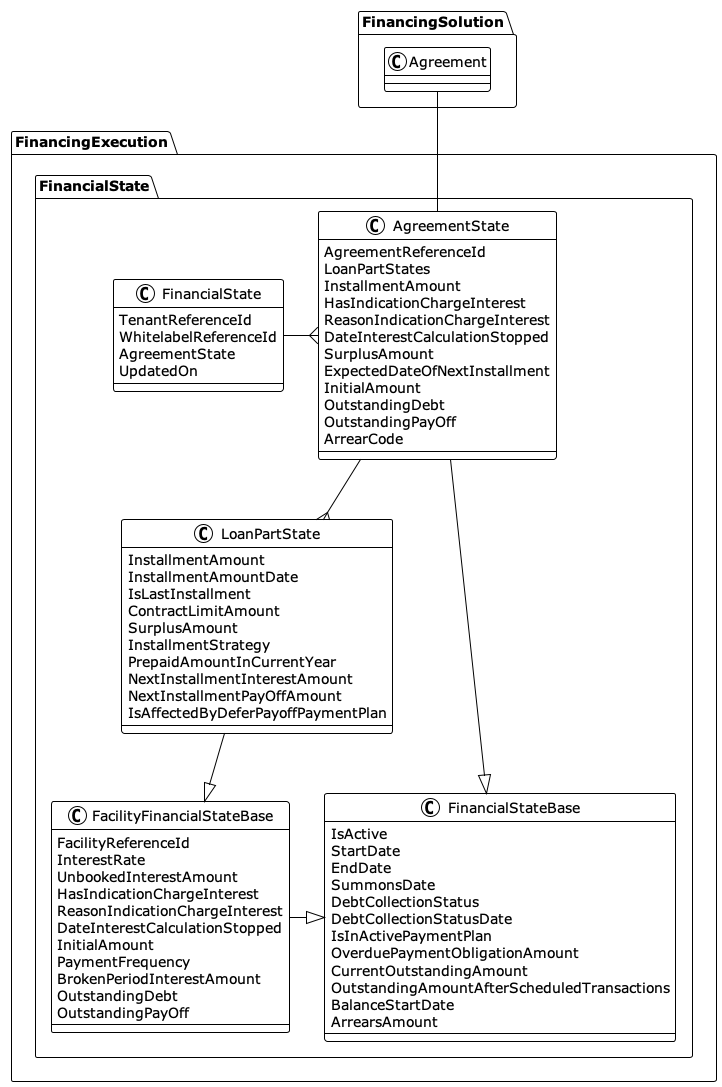
The financial state represents the overall financial status of a loan agreement at a specific point in time. It includes all relevant financial data, such as the agreement’s current state and last update timestamp. This lets you evaluate the agreement’s condition and calculate penalties in case of additional repayment.
To get information about the financial state of an agreement, use this Financing Execution Financial State API.
Payments
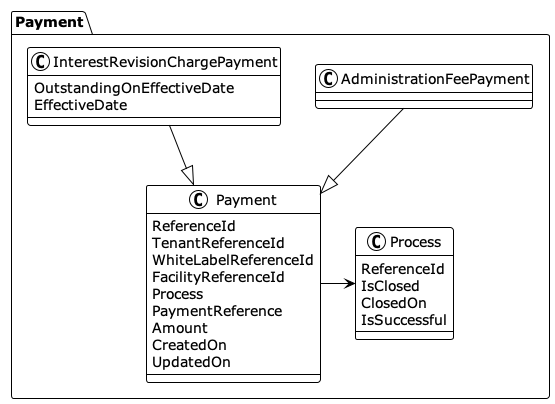
A payment represents a one-time charge related to processing costs that the borrower must pay. There are two types of payments:
- Administration fee: A payment covers administrative costs incurred by the lender to process the loan.
- Interest revision charge: A payment related to the adjustment of the loan’s interest rate that is charged by the lender.
To retrieve payment information, use this Payments Query API.
Bills
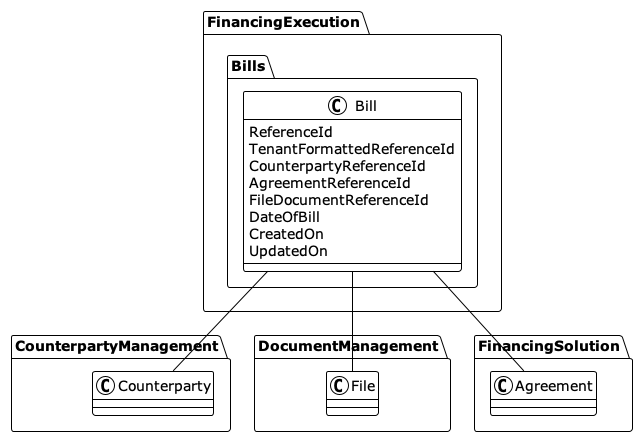
The Bill object contains metadata related to generated bills, which are used only for manual monthly payments. A bill can be associated with a counterparty, a loan agreement, or a file document.
For example, a bill is a generated document that provides the necessary information for a client to make manual monthly loan payments. While the actual document is stored in the Document Management domain, its basic metadata is stored in the Financing Execution domain. This makes it easy to track and manage generated bills by bill date or linked agreement.
To get a collection of bills, use this Bills Query API.
Additional repayments
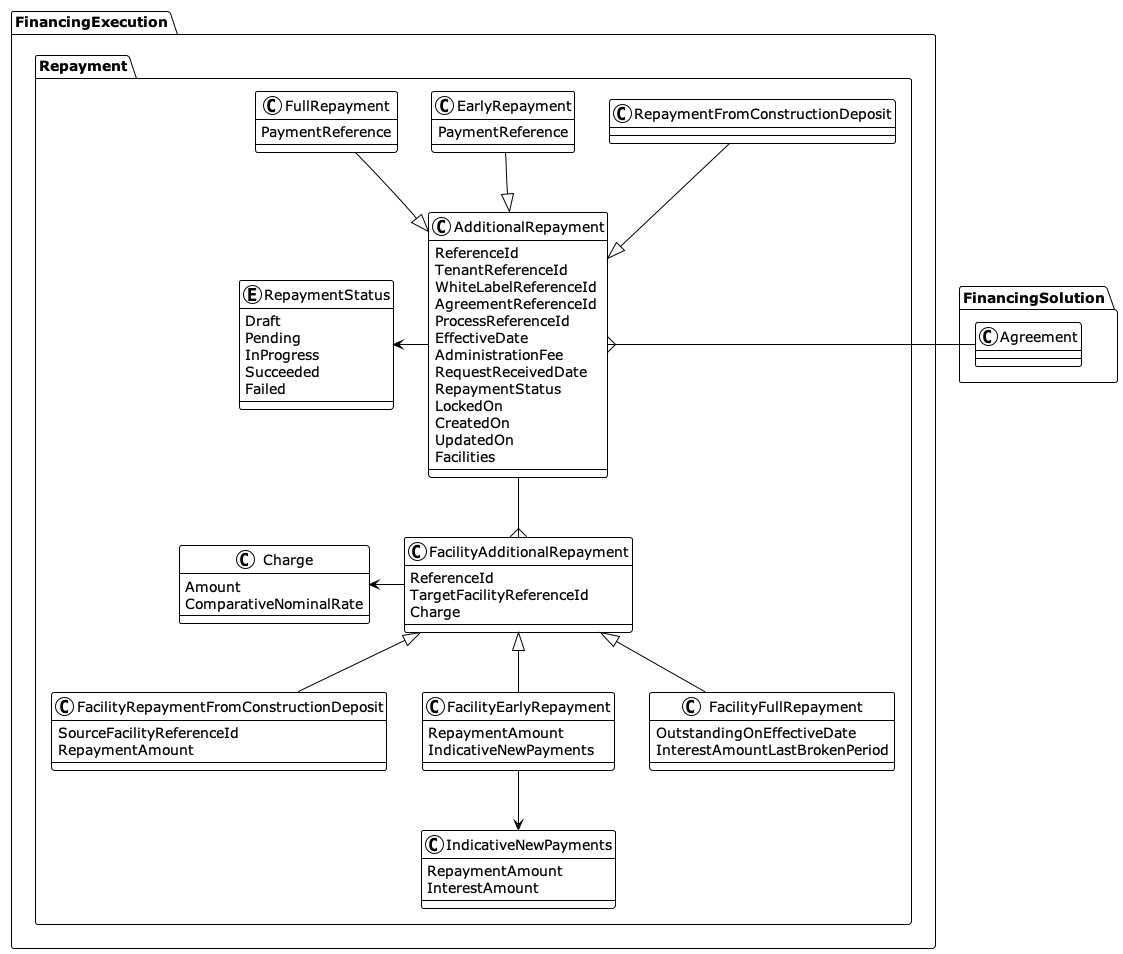
Additional repayments are payments made in addition to the scheduled repayments. This allows borrowers to pay their loans faster than the original plan and potentially pay less interest over the full loan term. In Akkuro Lending, additional repayments fall into three types: Repayments from construction deposits, Early repayments, and Full repayments.
The FacilityAdditionalRepayment object records the facility details of an additional repayment, including repayment type. Its subtypes correspond to the three repayment types above: FacilityRepaymentFromConstructionDeposit, FacilityEarlyRepayment, and FacilityFullRepayment.
To retrieve additional repayment records, use one of the following APIs:
- Additional Repayments Operational Query API to retrieve operational data.
- Additional Repayments Master Query API to retrieve master data records.
Repayments from construction deposits
A repayment from a construction deposit occurs when a borrower has a construction deposit account, a portion of these funds can be applied directly to partially reduce the loan principal.
Early repayments
An early repayment occurs when a borrower decides to pay extra on top of the regular monthly payment. These payments are made directly from the borrower's bank account to pay part of the loan before the scheduled due date.
To retrieve early repayment data, use one of the following APIs:
- Early Repayments Operational Query API to retrieve operational data.
- Early Repayments Master Query API to retrieve master data records.
Full repayments
A full repayment occurs when a borrower decides to fully settle the loan before the scheduled due date. These payments are made directly from the borrower's bank account, which completely repays the remaining loan balance.
To retrieve full repayment data, use one of the following APIs:
- Full Repayments Operational Query API to retrieve operational data.
- Full Repayments Master Query API to retrieve master data records.