Counterparties
Overview
This document provides diagrams that illustrate relationships within the Counterparty domain. By understanding this model, you can visualize the complete data structure behind the Counterparty API, including how their classes and attributes are organized, and how relationships between them are represented.
For a detailed description of each class and its attributes, refer to the Counterparty management API.
Counterparties
In the Akkuro Lending platform, a counterparty represents a borrower. They can be either a person or an organisation that takes a loan from a bank, money lender, or financial institution.
The following diagram illustrates the Counterparty domain model.
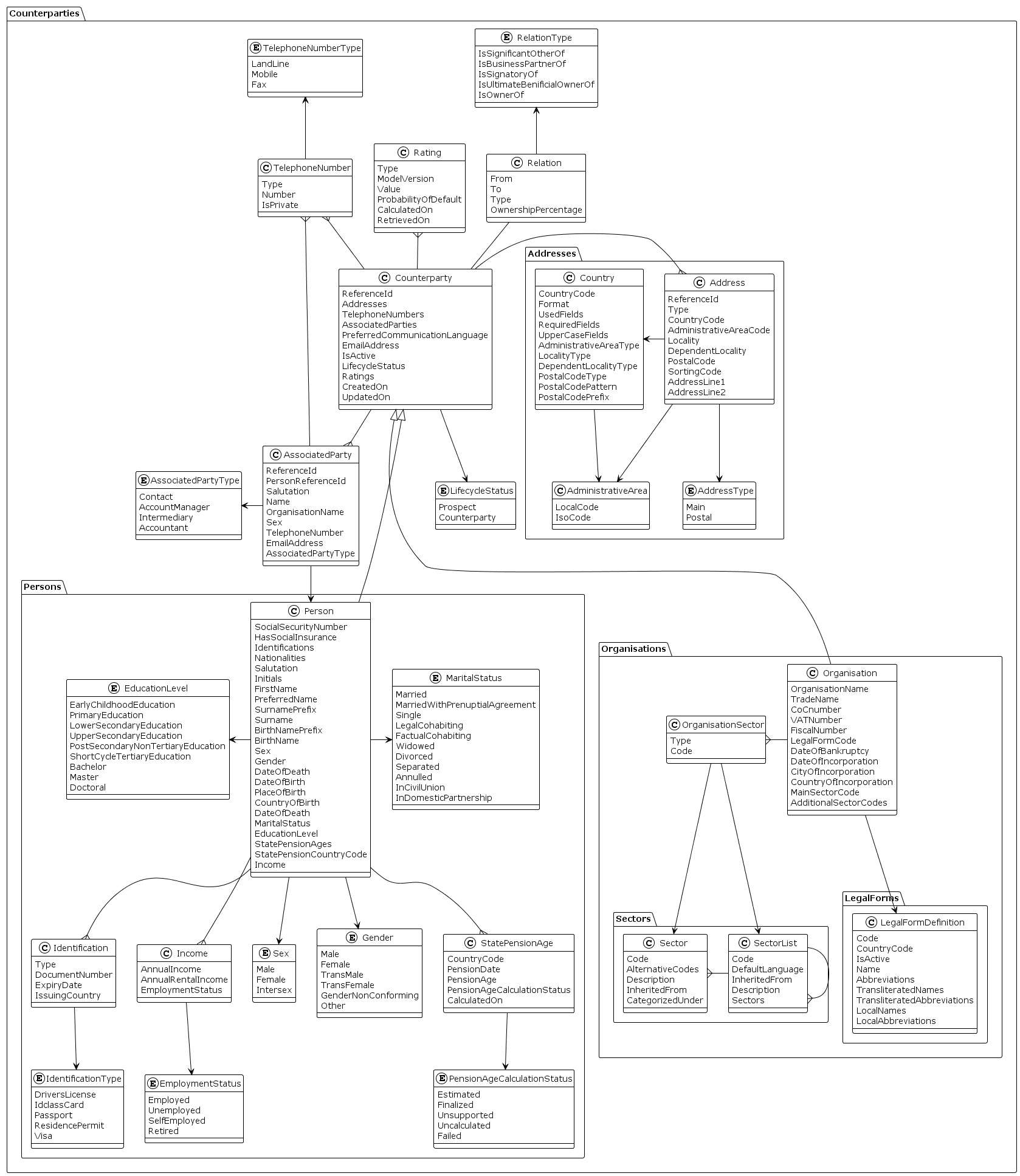
- To view the diagram in full size, right-click and select Open Image in New Tab.
- To learn how to read the diagram, see How to read these diagrams.
To retrieve counterparty information, use one of the following APIs:
- Counterparty Query Operational API retrieves operational-level data.
- Counterparty Query Master API retrieves master data records.
Addresses
Refer to Addresses for further information.
Persons
A counterparty can be an individual who borrows money. The Person class is a specialization of the Counterparty class. In other words, it inherits all properties of a counterparty and defines additional or more specific properties unique to a person.
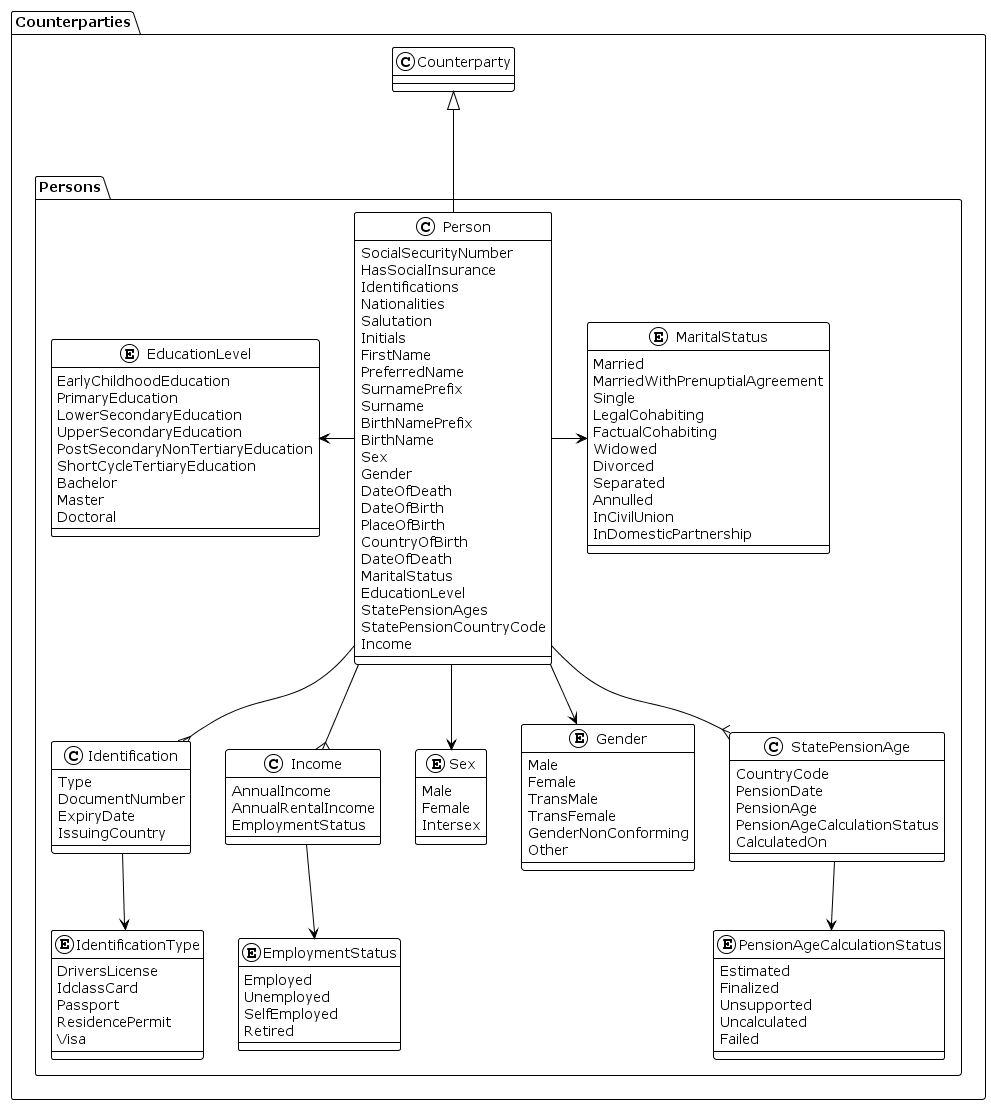
To retrieve a collection of identifications, use one of the following APIs:
- Person Query Operational API retrieves operational-level data.
- Person Query Master API retrieves master data records.
Education levels
Akkuro Lending uses the ISCED 2011 levels of education to indicate the highest level of education completed by a person.
Organisations
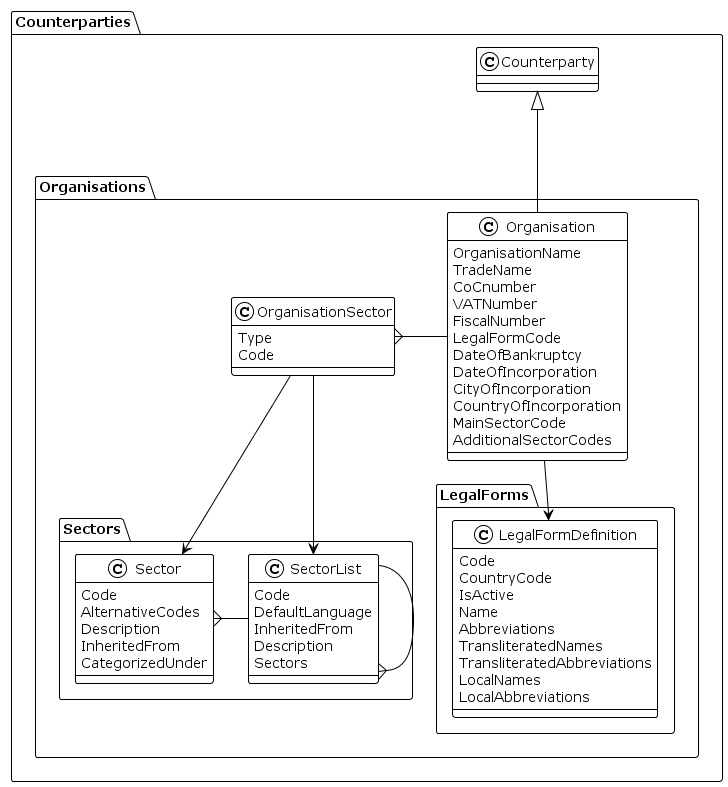
A counterparty can be an organisation that borrows money. The Organisation class is a specialization of the Counterparty class. In other words, it inherits all properties of a counterparty and defines additional or more specific properties unique to an organisation. Organisations are classified by sector and linked to their legal form.
The following diagram shows properties specific to an organisation:
Sectors
To retrieve all data related to a sector, use the Sectors API.
A sector represents the industry or economic activity classification of a borrowing organisation, such as manufacturing, retail, or healthcare. It is used to categorize counterparties for reporting, compliance, and risk assessment purposes.
The following sector classification lists are supported:
- ISIC: The International Standard Industrial Classification of All Economic Activities.
- NACE: Statistical Classification of Economic Activities in the European Community. NACE is derived from the ISIC classification system.
- SBI: Dutch Standard Business Classification. SBI is derived from the NACE classification system.
- NOGA: Swiss Standard Business Classification. NOGA is derived from the NACE classification system.
A SectorList defines a classification system (such as NACE and ISIC) and contains multiple Sector objects. Each sector can inherit properties from another code and be categorized under a parent sector. The current domain model supports cross-referencing.
The following is an example of a SectorList object for NACE:
{
    "code": "NACE",
    "defaultLanguage": "en-GB",
    "inheritedFrom": "ISIC",
    "description": "Statistical Classification of Economic Activities in the European Community",
    "sectors": [
        {
            "alternativeCodes": [],
            "code": "01.1",
            "description": "Growing of non-perennial crops",
            "isActive": true
        },
        // Additional sectors
    ]
}
The following are examples of Sector objects within the NACE list:
{
    "inheritedFrom": "0111",
    "categorizedUnder": "01.1",
    "isCategory": false,
    "sectors": [],
    "alternativeCodes": [],
    "code": "01.11",
    "description": "Growing of cereals (except rice), leguminous crops and oil seeds",
    "isActive": true
},
{
    "inheritedFrom": "0112",
    "categorizedUnder": "01.1",
    "isCategory": false,
    "sectors": [],
    "alternativeCodes": [],
    "code": "01.12",
    "description": "Growing of rice",
    "isActive": true
},
...
Legal forms
To retrieve information about legal forms, use the Legalform Query API.
A legal form defines the legal structure of a borrowing organisation. For example, an organisation can be a limited liability company, partnership, or sole proprietorship. It determines the organisation’s legal status, ownership model, and regulatory obligations.
Akkuro Lending uses a global list of legal forms to support international tenants. Each legal form is identified by a unique code. You can download the set of legal form code lists from the ISO 20275: class Legal Forms Code List page.
In the platform UI, legal forms may exist in multiple languages. When requested, the API returns the legal form name in the user’s system language if it exists in localNames. If no match is found, the API returns the first available entry in transliteratedNames.
The following is an example of a LegalForm:
{
    "code": "AABD",
    "countryCode": "string",
    "localNames": {
        "nl": "Naamloze vennootschap"
    },
    "transliteratedNames": {
        "en": "International Business Corporation"
    }
}
It contains the following fields:
code: Legal form code.countryCode: Country code.localNames: Contains the official name of the legal form in the local language of the country or region.transliteratedNames: Contains a standardized or transliterated version of the legal form name.