Collaterals
Overview
This document provides diagrams that illustrate relationships within the Collateral Management domain. By understanding this model, you can visualize the complete data structure behind the Collateral Management API, including how their classes and attributes are organized, and how relationships between them are represented.
For a detailed description of each class and its attributes, refer to the Collateral Management API.
Collateral management
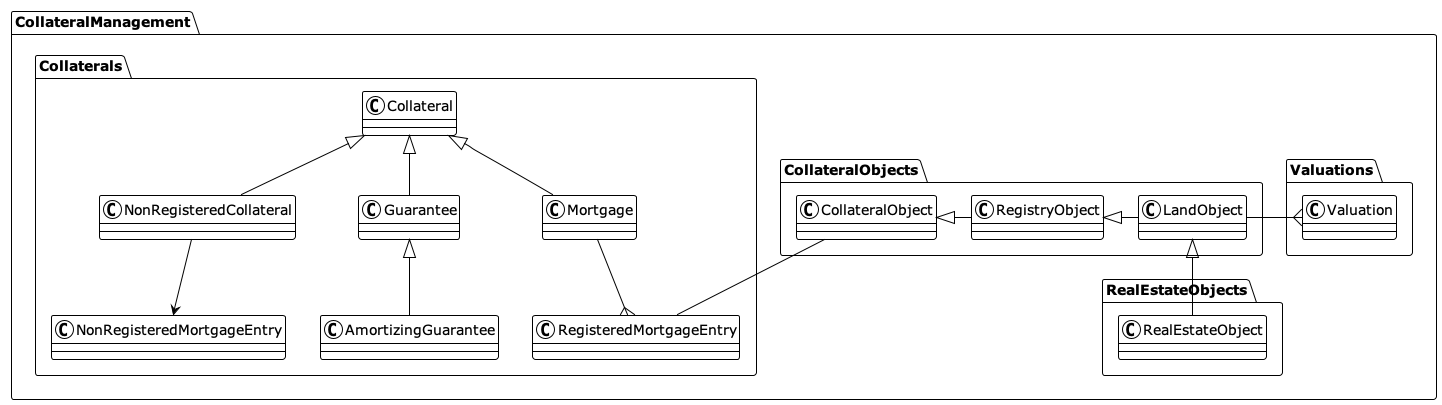
The following diagram provides an overview of the relationships within the Collateral Management domain:
- To learn how to read the diagram, see How to read these diagrams.
The Collateral Management domain includes the following subdomains:
Relationships between specific classes are described in each subdomain’s class diagram.
Collaterals
- To view the diagram in full size, right-click it and select Open Image in New Tab.
- To learn how to read the diagram, see How to read these diagrams.
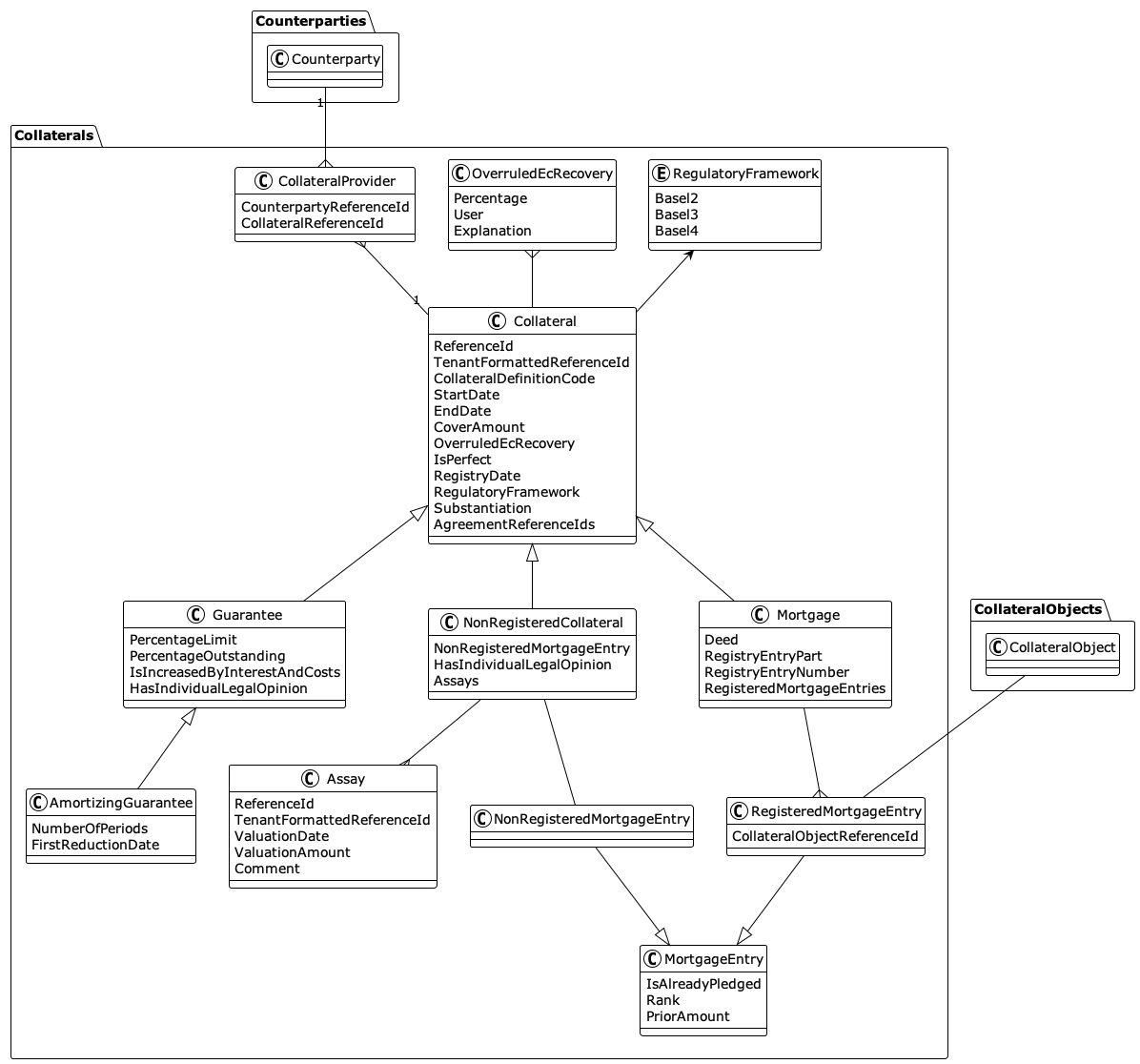
In the Akkuro Lending platform, collateral refers to an asset or item that has been accepted by the lender as security in a loan agreement with the borrower. If the borrower fails to repay the loan, the lender has the right to seize and liquidate the asset to recover the outstanding balance.
To retrieve collaterals and collateral providers information, use one of the following APIs:
- Collaterals Query Operational API retrieves operational data.
- Collaterals Query Master API retrieves master data records.
Collateral types
There are four (4) types of collaterals.
Mortgage
A mortgage is a type of collateral where real estate property (such as land or buildings) is pledged to secure a loan. If the borrower defaults, the lender has the legal right to seize and sell the property to recover the loan.
NonRegisteredCollateral
Non-registered collateral refers to assets pledged as security for a loan that are not officially recorded in a public registry. These can include movable assets like inventory, equipment, or receivables. These assets still serve as collateral, but enforcement may be more challenging due to the absence of public registration.
Guarantee
A guarantee is a contractual commitment in which a third party (the guarantor) agrees to repay a loan if the borrower fails to do so. Guarantees are often used to reduce lender risk and improve the creditworthiness of a borrower.
AmortizingGuarantee
An amortizing guarantee is a type of guarantee where the guaranteed amount decreases over time, typically in alignment with the loan’s repayment schedule.
CollateralObjects
- To view the diagram in full size, right-click it and select Open Image in New Tab.
- To learn how to read the diagram, see How to read these diagrams.
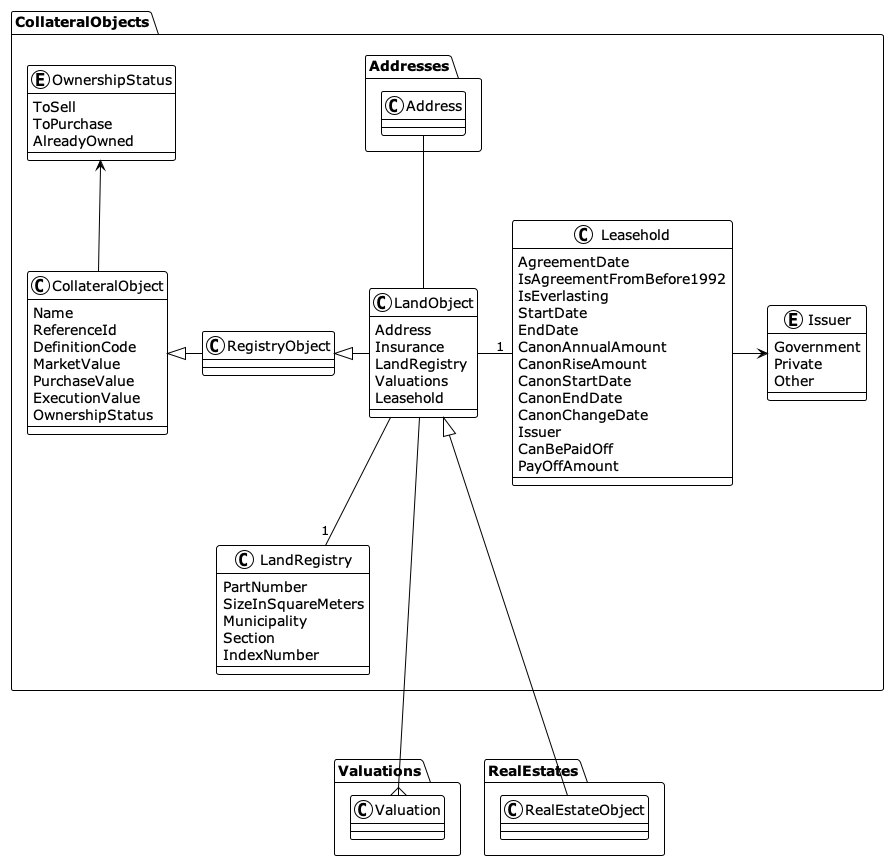
In the Akkuro Lending platform, a collateral object represents one or more real assets currently owned by the borrower. These assets are used to verify ownership and legal status, and to assess their value for loan approval and risk evaluation.
To retrieve collateral objects and their addresses, use one of the following APIs:
- Collateral Objects Operational Query API retrieves operational data.
- Collateral Objects Master Query API retrieves master data records.
Definition codes
There are multiple types of collateral objects, they can be land, a family house, a shop, an airplane, a ship, and other assets. Therefore, each collateral object is provided with a definition code to identify its type.
Addresses
Refer to Addresses for further information.
LandObject
A LandObject represents a physical asset consisting of undeveloped or agricultural land. This can include properties such as farms, fields, or plots of land.
A specialized form of LandObject is the RealEstateObject, which represents land with built structures.
Valuations
- To view the diagram in full size, right-click it and select Open Image in New Tab.
- To learn how to read the diagram, see How to read these diagrams.
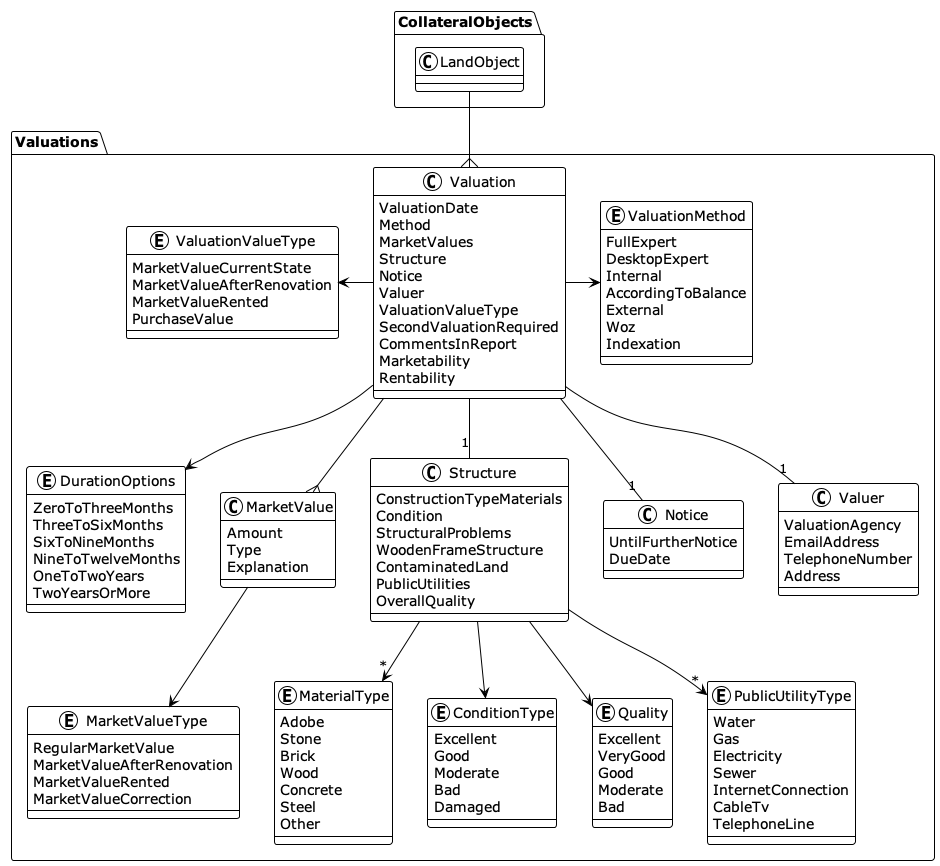
To determine the fair market value of a LandObject, a valuation is performed. A valuation is an assessment of the asset’s worth when registered as a collateral object. It helps lenders evaluate the asset’s value for loan approval and risk assessment.
A single LandObject can have multiple valuations. These valuations may be based on different criteria, such as the asset's structure (such as quality, condition, and material type), market value, and other relevant factors. Each set of criteria may result in a different assessed value for the same asset.
To retrieve a list of valuations, use one of the following APIs:
- Valuation Query Operational API retrieves operational data.
- Valuation Query Master API retrieves master data records.
RealEstateObjects
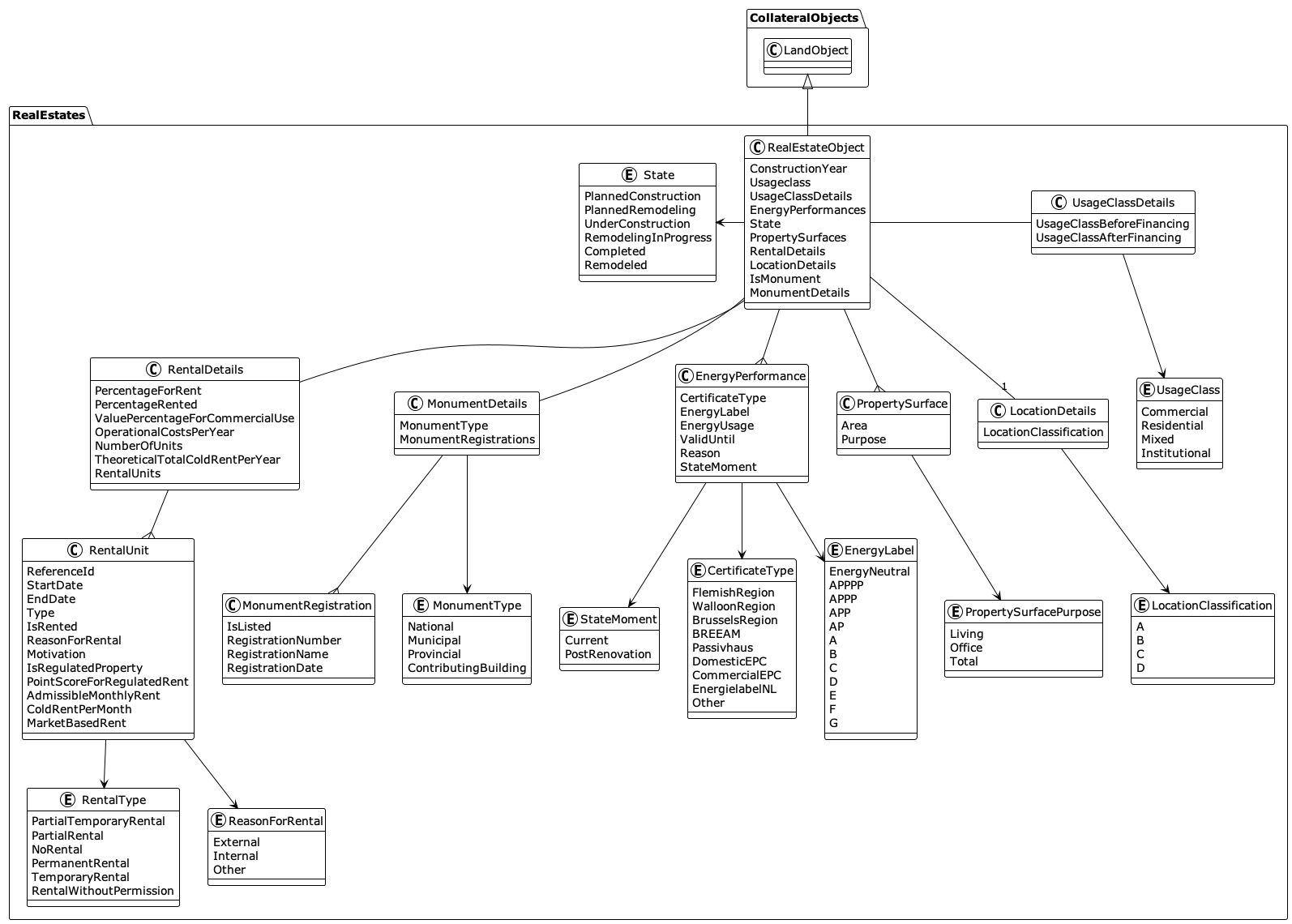
- To view the diagram in full size, right-click it and select Open Image in New Tab.
- To learn how to read the diagram, see How to read these diagrams
A RealEstateObject is a specialization of LandObject that represents land with built structures intended for living, working, or other human activities. This includes residential properties (such as houses and apartments), commercial buildings (such as offices and retail spaces), mixed-use developments, or institutional properties (such as schools and churches).
Rental details
Rental details represent information about a RealEstateObject that generates income through renting. The rental details consist of the number of units, how many of the available units are rented out, and information about the financials associated with it.
To retrieve a list of of rental units, use one of the following APIs:
- Rental Unit Query Master API retrieves master data records.
- Rental Unit Query Operational API retrieves operational data.